
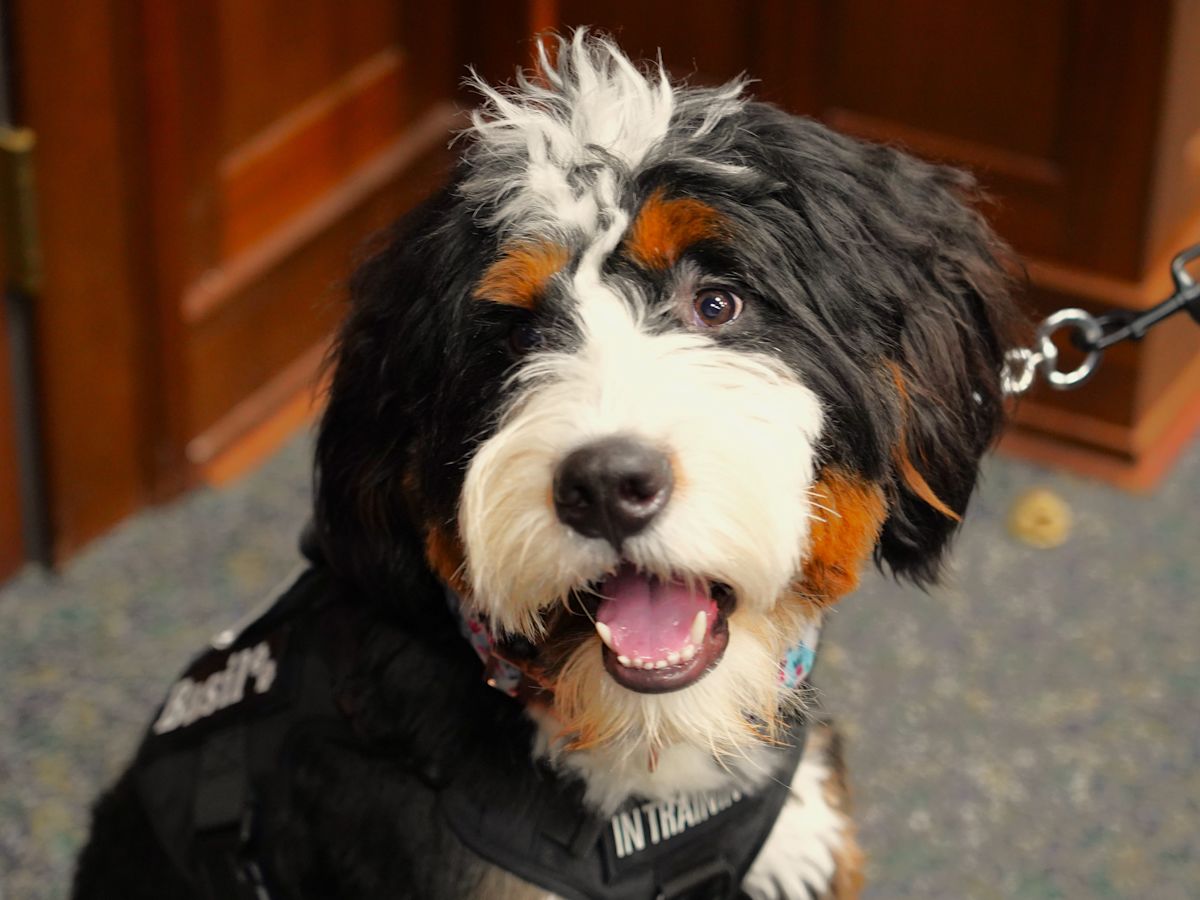
Receiving a jury summons in the mail is rarely met with enthusiasm, but individuals summoned for grand jury duty in Hamilton County encounter a distinctly unique support system. Alongside prosecutors, detectives, and witness files, jurors in the county are greeted by Basil, a resident therapy dog whose presence helps ease the strain of hearing difficult legal proceedings.
Recognizable by a small vest bearing his name, Basil sports a shaggy mop of white fur and a friendly disposition as he wanders the halls of the prosecutor’s office. His official duties include comforting crime victims and their loved ones, but he also spends significant time interacting with citizen jurors who must review distressing evidence during their civic service.
Beyond the soothing company of a four-legged companion, serving on a local grand jury carries practical advantages that distinguish it from standard trial duty. Jurors avoid the long security queues typical of the main courthouse because their proceedings take place just down the street in the prosecutor’s office building on Ninth Street.
The structure of a grand jury differs dramatically from the dramatic trials often depicted on television. Grand jurors do not sit in traditional, spacious courtrooms, nor do they decide whether an accused person is guilty or innocent. Instead, citizens selected from local voter registration records and driver's license databases assemble almost every weekday to serve as an essential screening panel for the regional justice system.
Across the United States, roughly half of all states utilize grand juries to evaluate evidence before formal criminal charges proceed. Under Ohio law, these citizen bodies focus on serious felony matters rather than minor violations, evaluating all felony charges in Hamilton County along with any misdemeanor offenses directly connected to them.
Rather than determining ultimate guilt beyond a reasonable doubt, grand jurors operate under the standard of probable cause. In guidance provided by the Ohio Judicial Council, the panel’s primary directive is to evaluate whether the presented evidence is credible and reliable enough to establish that the accused person probably committed the alleged crime.
The dynamic inside the grand jury chamber is also markedly different from a trial setting. Neither the accused person nor defense counsel is present to offer arguments or testimony during the hearings. However, grand jurors possess the authority to directly question police officers, investigators, and other witnesses who appear before them to lay out the state's evidence.
Each grand jury panel consists of nine members alongside alternates. For an indictment to be issued and allow a criminal prosecution to move forward, at least seven of the nine jurors must vote in favor of the charges.
If the state fails to secure the necessary seven votes, the panel issues what court officials refer to as a "no bill," effectively ignoring the matter and resulting in the charges being dropped. Even so, the dismissal does not permanently close the door to prosecution, as prosecutors retain the ability to present the case to a future grand jury if fresh evidence is uncovered.
Given the large population of Hamilton County, the workload for these panels is substantial. While smaller Ohio jurisdictions may only convene grand juries periodically, Hamilton County maintains two separate nine-member panels, plus alternates, working Monday through Friday throughout the entire year, taking off only for certain holidays.
Hamilton County Prosecutor Connie Pillich noted that this rigorous schedule resulted in grand juries reviewing more than 5,700 cases over the course of 2025. Jurors typically serve a two-week term, during which a single panel may evaluate 100 or more criminal cases.
The heavy daily demand is etched directly into the physical environment of the Ninth Street offices. Decades of continuous service have left the wood-paneled walls noticeably worn and scarred from the backs of juror chairs rubbing against them during countless hours of deliberations.
To improve the working conditions in these somewhat cramped meeting spaces, Kate Burroughs, who has served as the Chief of Grand Juries and Intake since January 2025, spearheaded an effort to update the rooms. With the help of her daughters, Burroughs cleaned the facilities, repaired worn-down chairs, installed new tables, and added television monitors. The monitors solved a logistical issue, as detectives previously had to circulate around the room displaying photos and video evidence directly from their cellphones.
To help incoming citizens manage the demanding docket, the initial day of service focuses on legal orientation. Jurors receive instruction on key statutory definitions, including the legal meanings of acting knowingly or recklessly, the concept of possession, and current state firearm statutes, followed by a lighter initial caseload to help them get acclimated.
According to Pillich, grand jury proceedings are straightforward and free of courtroom theatrics. The vast majority of matters reviewed by the panels involve drug possession and drug trafficking allegations, providing jurors with an up-close look at the daily operations of the criminal justice system while Basil provides a calming presence throughout the process.





(0)