
A major emergency search and rescue operation is taking place across the Java Sea after an Indonesian passenger vessel overturned in severe weather conditions, leaving approximately 130 passengers and crew members missing. Emergency response teams rushed to the area to locate survivors amid dangerous maritime conditions that triggered the disaster.
Search teams have successfully pulled at least 107 survivors from the water, while recovery workers have located the bodies of six passengers who perished in the incident. Operations have intensified and widened significantly around the vessel's last recorded coordinates as authorities race against time to find additional survivors adrift in open water.
The stricken ship, identified as the Virgo Transport 8, had been navigating a standard inter-island transit route from the port city of Surabaya in East Java toward its destination of Banjarmasin, located in the South Kalimantan province on Borneo Island. The vessel was carrying more than 240 individuals alongside a substantial cargo of vehicles when the emergency unfolded.
Prior to losing all communication, the ferry’s captain had warned of severely deteriorating conditions at sea, detailing rough waters and swells reaching heights of up to 10 feet. The shipmaster issued an urgent distress transmission informing authorities that the vessel was dangerously listing to one side, shortly before the ship fully capsized under the pressure of the heavy waves.
According to I Putu Sudayana, the head of the Banjarmasin Search and Rescue Office, local monitoring stations lost contact with the Virgo Transport 8 at roughly 2 a.m. on Sunday. The regional rescue agency was formally alerted to the crisis approximately two hours later, immediately triggering the dispatch of emergency maritime assets toward the disaster zone.
Navigational data and initial emergency reports positioned the vessel’s final known location in the Java Sea, roughly 92 miles away from the port of Banjarmasin. Reaching the remote offshore area posed an immediate logistical challenge for first responders attempting to coordinate rapid life-saving interventions across a vast expanse of open water.
Official documentation from the ship's manifest recorded a total of 243 individuals on board, comprising 213 passengers and 30 crew members, in addition to 89 transport vehicles held on the car decks. Maritime authorities noted that in Indonesian sea travel, real passenger numbers regularly deviate from formal manifest paperwork, complicating early efforts to calculate exact casualty figures.
Indonesia’s Transportation Minister, Dudy Purwagandhi, stated that aerial reconnaissance flights confirmed the overturned ferry had not completely sunk beneath the surface. Instead, the vessel remained floating upside down, prompting tactical rescue teams to focus their primary surface and diving sweeps in the immediate perimeter of the inverted hull.
To accelerate the search perimeter, emergency coordinators deployed a substantial maritime task force by Sunday afternoon. The response fleet grew to encompass eight vessels, including four Indonesian naval ships, accompanied by two reconnaissance helicopters providing continuous aerial surveillance over the choppy waters.
Back on land, scenes of deep anguish unfolded at Trisakti Port in Banjarmasin, where emergency management teams set up a dedicated crisis command post. Hundreds of anxious family members and relatives gathered at the terminal facilities, desperately seeking updates on loved ones who had boarded the ill-fated voyage in East Java.
Crowds of relatives anxiously scrutinized passenger registries and survivor lists displayed by emergency workers, hoping to find confirmation that their family members had survived the capsizing. While many waited in agonizing uncertainty, others experienced sudden moments of profound relief amid the tense atmosphere at the port terminal.
Among those waiting at the port facility was a woman named Bunga, who spoke of her shock upon discovering her uncle was registered aboard the stricken vessel. Her dread turned to gratitude after search and rescue personnel confirmed that he was among the 107 individuals successfully rescued from the sea by responding vessels.
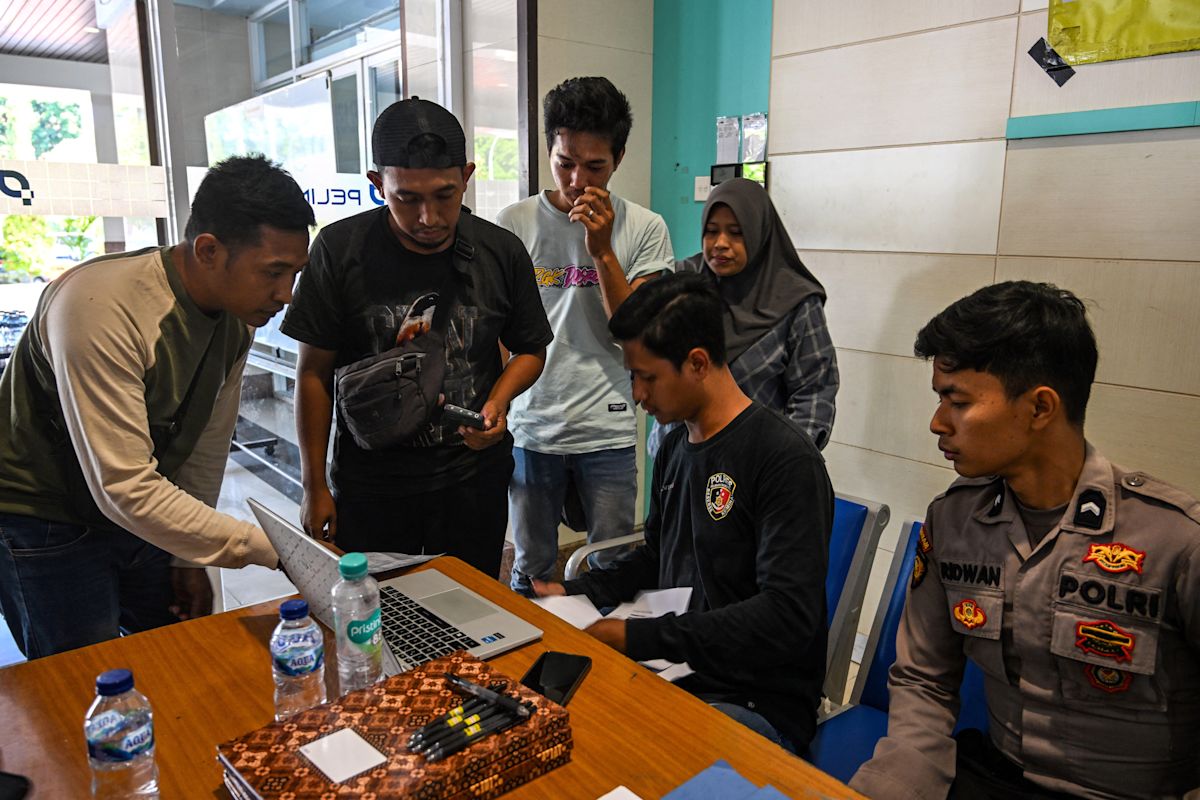
Port authorities and local police officers actively engaged with the assembled families at Trisakti Bandarmasih Port, collecting identifying details and assisting spouses and family members—such as Ela Nur Atika, whose husband was aboard the ferry—as they sought critical news regarding ongoing recovery operations.
Conducting rescue missions around an overturned, floating vessel in open seas presents severe hazards for emergency personnel. Strong currents, residual high waves, and the shifting weight of submerged vehicles inside the capsized hull require specialized nautical handling and round-the-clock naval coordination to avoid further mishaps.
The tragic incident once again underscores the critical safety challenges facing Indonesia's extensive maritime transportation sector. As an expansive archipelago spanning more than 17,000 islands, the nation relies heavily on ferry networks as a primary mode of domestic travel, yet the sector continues to experience recurring maritime disasters frequently tied to severe weather, overcrowding, and lax safety enforcement.





(0)