
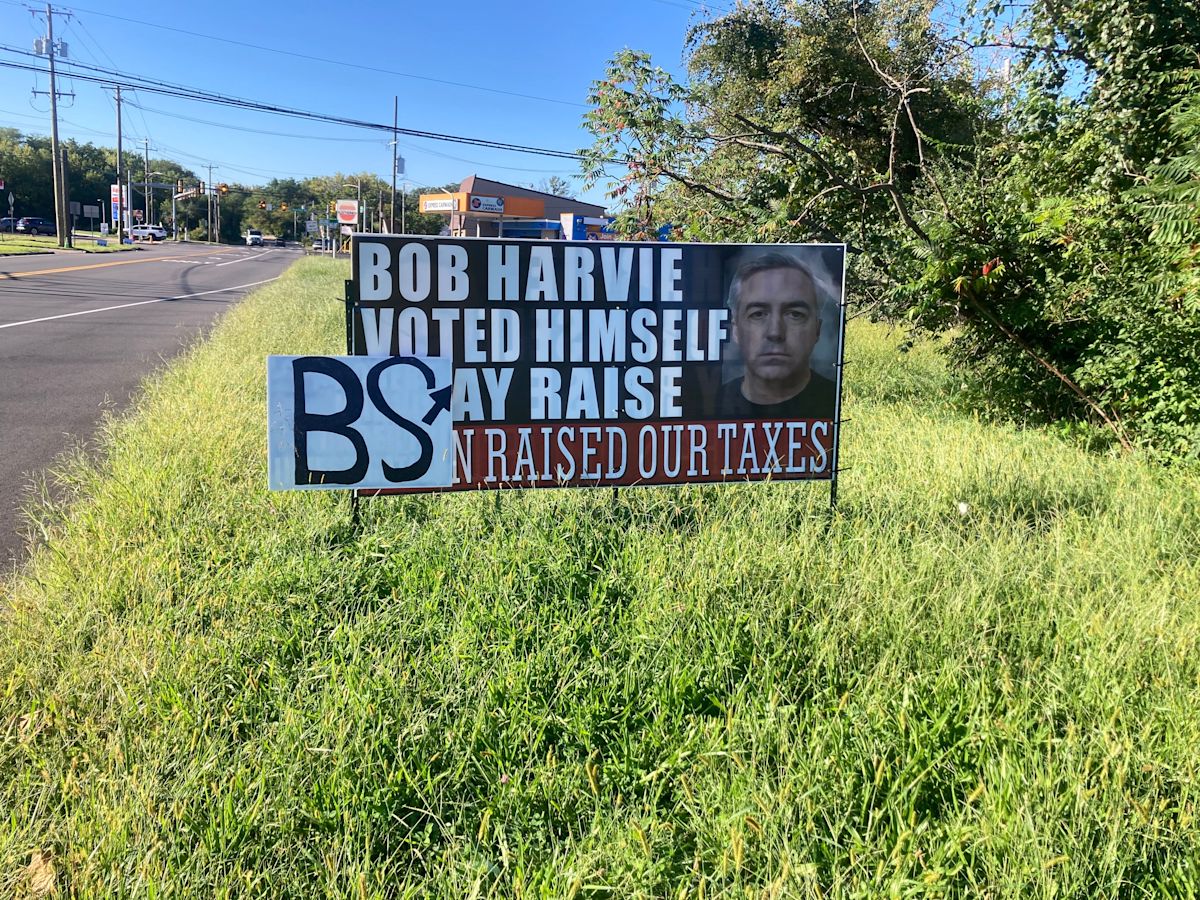
Local officials in Middletown Township are advancing sweeping revisions to the municipality’s public sign regulations, establishing a uniform set of standards for all temporary displays alongside potential fines reaching $500 per day. The proposed policy changes will impact a broad spectrum of everyday postings, ranging from real estate listings and service advertisements to seasonal political campaign signs.
The township’s board of supervisors voted unanimously to advertise the updated ordinance, taking a necessary step to align local municipal code with federal jurisprudence. The revision comes in direct response to a federal court determination requiring local governments throughout Pennsylvania to apply identical standards across all temporary public signage, rather than differentiating based on the message displayed.
The legal impetus stems from a May 2024 decision issued by the U.S. Third District Court regarding a sign dispute in Camp Hill Borough. In that case, the court determined that the borough had unconstitutionally favored commercial advertisements and residential "for sale" signs over political messages and individual expressions of opinion, thereby infringing upon First Amendment protections.
Judges in the Camp Hill matter criticized the municipality’s regulatory framework as a "crazy quilt" of inconsistent rules. Under that previous system, residents were restricted to displaying no more than two personal expression signs on their property, while commercial promotions and holiday greetings faced no comparable limitations. The federal ruling mandated that municipalities must regulate signs neutrally, without assessing their underlying content.
Political speech will experience notable shifts under Middletown’s revised measure. Campaign signs and political messaging will no longer be permitted to appear earlier than 30 days prior to an election date. Furthermore, property owners and campaign organizers will be required to completely remove all political displays within 10 days after voting concludes.
Beyond political campaigns, the ordinance extends to virtually all forms of temporary messaging placed throughout the community. Solicitations for youth sports registrations, private power-washing operations, seasonal contractors offering to hang holiday lights, and standard residential real estate signs will all fall under the exact same regulatory framework.
A central pillar of the proposed measure is a comprehensive prohibition against placing any sign inside public rights-of-way, which typically run along busy thoroughfares and intersections. Under the new draft, no temporary sign will be authorized within these township-controlled spaces, regardless of whether the message is commercial, civic, or political in nature.
State-maintained corridors within the township are also subject to strict limitations. Sign prohibitions on Pennsylvania Department of Transportation rights-of-way, such as Bristol-Oxford Valley Road in Levittown, have existed for years, though municipal leaders acknowledge that proactive enforcement along these state routes has historically been minimal.
On private property, including residential front lawns, the township is instituting specific dimensional restrictions to maintain order and uniformity. The draft ordinance mandates that no individual temporary sign may exceed 12 square feet in size, and the cumulative area of all temporary signs on a single parcel cannot surpass 24 square feet.
Enforcing the new measure across Middletown presents practical hurdles given the community’s size. With roughly 50,000 residents, Middletown ranks among the most populous municipalities in Bucks County. Township Solicitor Jim Esposito noted that the local government lacks the resources to deploy specialized municipal crews dedicated exclusively to patrolling local roadways for non-compliant signs.
Instead, the township plans to rely primarily on a complaint-driven enforcement model paired with incidental municipal oversight. According to Esposito, municipal public works and road maintenance employees will remove unauthorized signs from public rights-of-way whenever they encounter them during the course of their everyday operational duties.
When formal violations arise, financial penalties can escalate quickly. Cases involving unapproved signage can be referred to local district justices, who possess the authority to levy fines of up to $500 per day for each ongoing violation. However, the township intends to exercise administrative discretion before pursuing formal legal sanctions.
Esposito emphasized that municipal officials prefer to grant leniency to initial violators, offering property owners and organizations an opportunity to correct infractions voluntarily. Formal court filings and daily monetary penalties will primarily target repeat offenders who deliberately ignore prior township directives and warnings to remove unlawful displays.
For signs situated entirely on private property—such as homeowner "for sale" boards or personal yard signs—township officials plan to take a measured, light-handed approach so long as the displays comply with dimensional caps and do not draw neighborhood complaints. By formalizing these standardized rules, Middletown aims to balance constitutional free-speech obligations with local community aesthetics and public safety standards.







(0)