
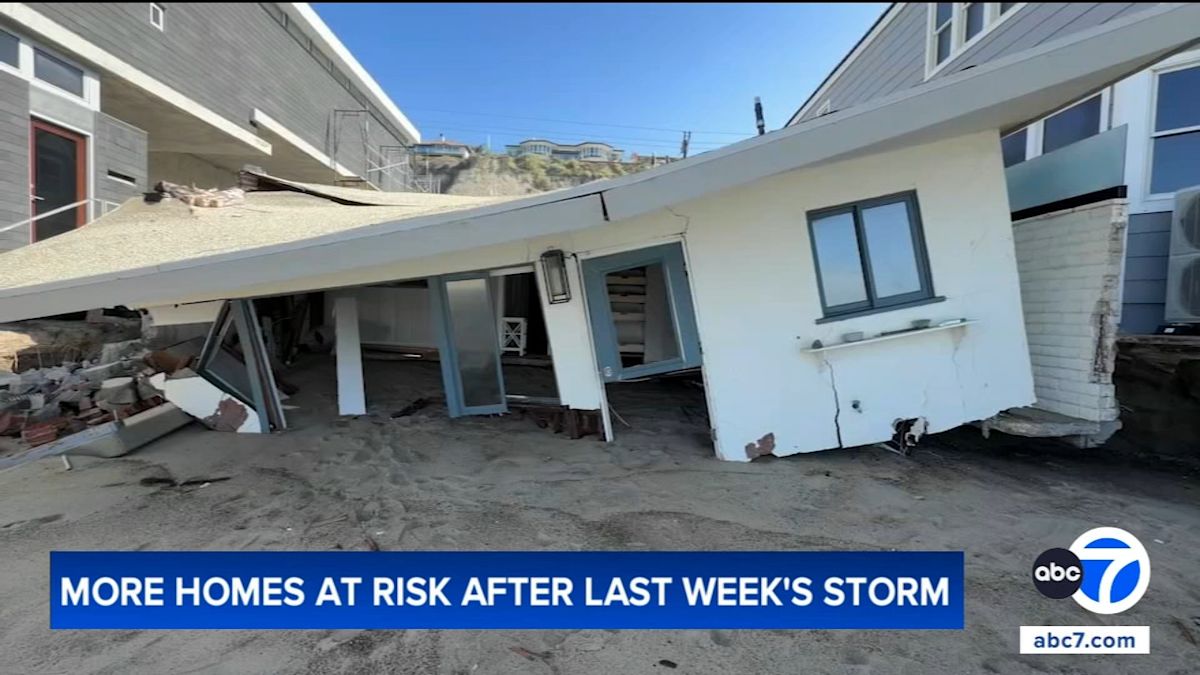
A deepening coastal crisis has intensified along the shoreline of Capistrano Beach, where severe erosion and violent surf have claimed another oceanfront residence and compromised numerous neighboring structures. In the wake of powerful swells generated by Hurricane Marie, waterfront homes have begun collapsing toward the ocean, prompting urgent safety evaluations by local building authorities and igniting deep frustration among impacted homeowners.
In response to the escalating structural threats along Beach Road, municipal officials in the city of Dana Point have officially proclaimed a local emergency. Building inspectors have already red-tagged ten residences, declaring them entirely unsafe for occupancy, while another seven properties have received yellow tags indicating restricted access due to moderate structural hazards.
The catastrophic toll of the storm is acutely evident at the property of local residents Amy and Chris Rogers. The ocean waves completely ripped away their rear outdoor deck, leaving their residential kitchen fully exposed to the open Pacific. The couple reported that their home is among those that have suffered severe destabilization as the underlying foundation continues to yield to the encroaching tides.
For many community members, the disaster has inflicted an immense emotional strain alongside overwhelming property losses. Residents noted that the neighborhood has experienced intense shock, grief, and growing indignation as they watch homes succumb to the water days after the storm’s peak intensity had already subsided.
Impacted property owners have voiced strong dissatisfaction with the lack of direct disaster assistance following the destruction. The Rogers stated that despite being a week removed from the onset of the destructive surge, no practical recovery resources, financial assistance, or coordinated labor have been deployed to the area by municipal, county, state, or federal emergency management agencies to help stabilize their immediate surroundings.
Residents contend that the disaster was largely preventable, attributing the rapid destruction to restrictive coastal preservation rules and a severe deficiency of sand replenishment initiatives. Decades of coastal retreat have stripped the beach of natural sand buffers, leaving beachfront residences exposed directly to high-energy wave impacts without sufficient nourishment projects to restore protective shorelines.
The regulatory environment governing California's coastline has become a central point of contention for homeowners attempting to safeguard their parcels. Residents report feeling constrained by regulatory bodies, arguing that existing legal frameworks prevent them from installing timely shoreline protections while sand supplies continue to diminish rapidly along the coast.
In an effort to provide short-term relief, a spokesperson for the California Coastal Commission confirmed that the state regulatory agency has approved emergency permit applications across seventeen individual properties. These temporary authorizations permit homeowners to carry out emergency armoring measures, including the strategic placement of massive boulders seaward of threatened structures.
However, property owners have criticized the regulatory requirements attached to these temporary emergency permits. Securing authorization requires homeowners to submit a $1,600 application fee by mail for a provisional approval window that remains valid for only 120 days. Under state rules, once this four-month period expires, property owners are mandated to remove every piece of protective armoring installed during the emergency.
The California Coastal Commission maintains that long-term hard armoring, such as boulder revetments and seawalls, ultimately accelerates coastal erosion and causes severe degradation to publicly accessible beaches. The placement of rigid barriers frequently prevents the natural movement of sand, exacerbating erosion on adjacent shorelines and shrinking public coastal access.
Homeowners acknowledge the environmental drawbacks of hard armoring, agreeing with state officials that boulder placements are far from an ideal permanent fix. Residents have emphasized that their ultimate goal is not to line the coast with rock barriers, but rather to secure large-scale, sustainable sand nourishment programs that replenish the entire beach ecosystem.
Political efforts are now underway to unlock broader disaster relief resources for the battered coastal stretch. A representative for California Assemblywoman Laurie Davies announced that the lawmaker is actively petitioning Governor Gavin Newsom to issue a comprehensive State of Emergency declaration covering the entire affected coastal zone.
Such a gubernatorial declaration could potentially streamline administrative approvals, release emergency state disaster funds, and facilitate broader interagency support for affected coastal communities facing ongoing structural instability.
For now, residents along Capistrano Beach remain caught in a state of precarious uncertainty. Homeowners such as the Rogers are currently awaiting determinations from their insurance providers to discover whether their compromised properties can be structurally rehabilitated or whether the remaining structures will have to be completely demolished and rebuilt.


(0)